Jump to a section
A screen protector can be extremely hard, highly flexible, almost invisible or easy to install—but no single material leads in every category. For most conventional flat-screen phones, a high-quality, model-specific and fully adhesive tempered-glass protector is the strongest all-round starting point. For a deeply curved display or most smartwatches, flexible TPU or hydrogel-labelled film is often more practical. PET is a slim, affordable choice for basic abrasion protection, matte finishes and minimal added thickness.
Which screen protector is best? The quick decision table
Start with the shape of the display and the feature you care about most. These recommendations describe sensible starting points, not guarantees: thickness, coating, adhesive, edge design and manufacturing quality can change how an individual protector performs.
Best screen-protector type by situation
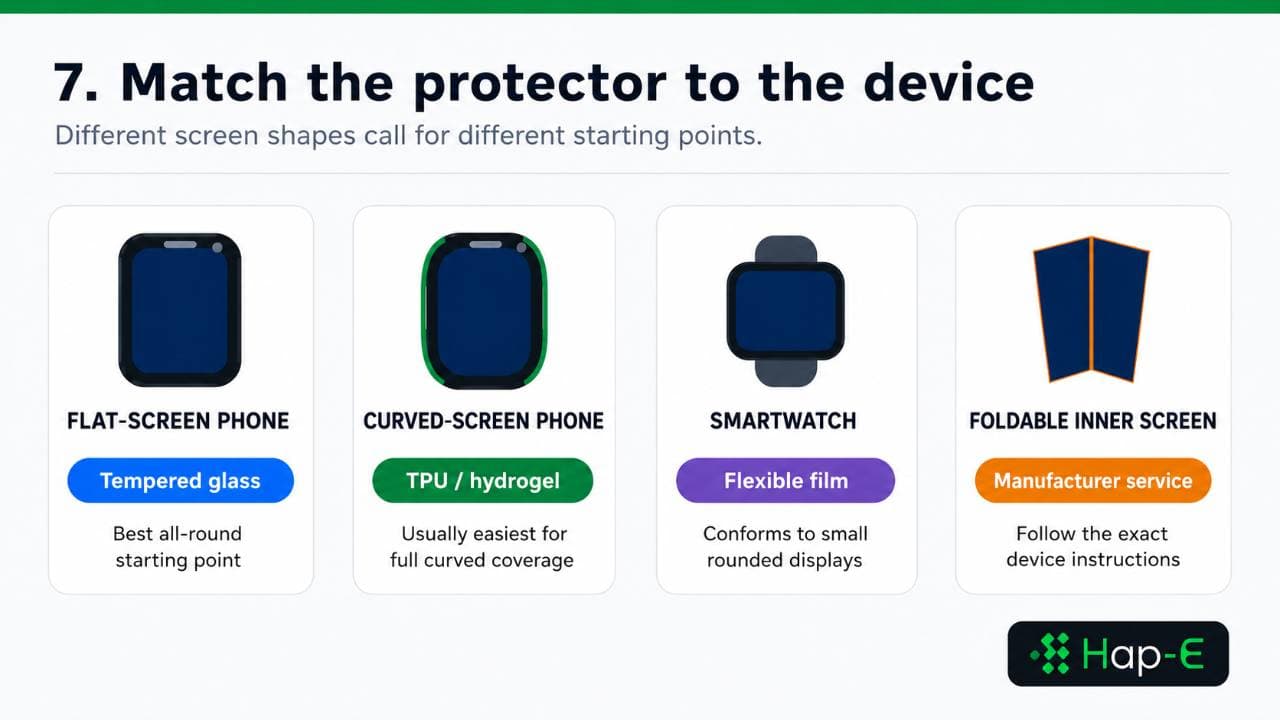
Flat-screen phone
Strongly curved phone
Sharp-object or point-impact risk
Broad, blunt knocks
In-display fingerprint reader
Matte or anti-glare preference
Smartwatch with a curved face
Foldable inner display
| Situation | Recommended starting point | Why | Main caution |
|---|---|---|---|
| Flat-screen phone | Tempered glass | Strong scratch protection and a natural glass-like feel | It can crack; check fingerprint compatibility |
| Strongly curved phone | TPU or hydrogel-labelled flexible film | Conforms more easily to curved edges | A softer surface may show dents or deep gouges |
| Sharp-object or point-impact risk | Quality glass plus a protective case | Glass has stronger direct evidence for concentrated sharp impacts | No protector guarantees display survival |
| Broad, blunt knocks | Glass or quality TPU plus a case | TPU performed comparably to glass under tested blunt impacts | Results vary by thickness and construction |
| In-display fingerprint reader | Certified or explicitly model-compatible protector | Thickness, adhesion and bubbles affect recognition | Re-register fingerprints after fitting |
| Matte or anti-glare preference | Matte PET or matte film | Thin construction with intentional light diffusion | Matte surfaces can reduce apparent sharpness |
| Smartwatch with a curved face | TPU, hydrogel or TPU/PET composite | Flexible coverage around a small curved display | Check clearance with a watch case or bumper |
| Foldable inner display | Manufacturer-approved service process | The display and factory protector form a folding system | Do not treat it like a conventional phone screen |
What tempered glass, hydrogel, TPU and PET actually mean
Tempered or strengthened glass
A glass protector is a rigid sheet manufactured to sit above the original display. Listings may call it tempered glass, chemically processed glass or strengthened glass. Its principal advantages are a hard surface, smooth finger glide and a feel close to the original display. Its principal disadvantage is that it can chip or crack, particularly at an exposed edge. Glass must be model-specific because speaker openings, display curves, sensor requirements and case clearance differ between phones.
TPU film
Thermoplastic polyurethane, or TPU, is a flexible and elastic polymer. Those properties help it follow curves and deform without shattering. Some TPU products add a surface layer designed to make fine impressions less visible over time, but self-healing is product-specific. A puncture, missing coating or cut through the film will not disappear. Depending on its finish, TPU can feel slightly softer or more rubber-like than glass.
PET film
Polyethylene terephthalate, or PET, is a polyester film valued for strength, dimensional stability, optical clarity and its ability to accept specialist coatings. Compared with TPU, PET is normally less elastic and feels crisper. It can be extremely thin and works well for clear, matte, privacy or anti-glare finishes. Think of PET primarily as an abrasion and surface-wear layer rather than the first choice for serious impact protection.
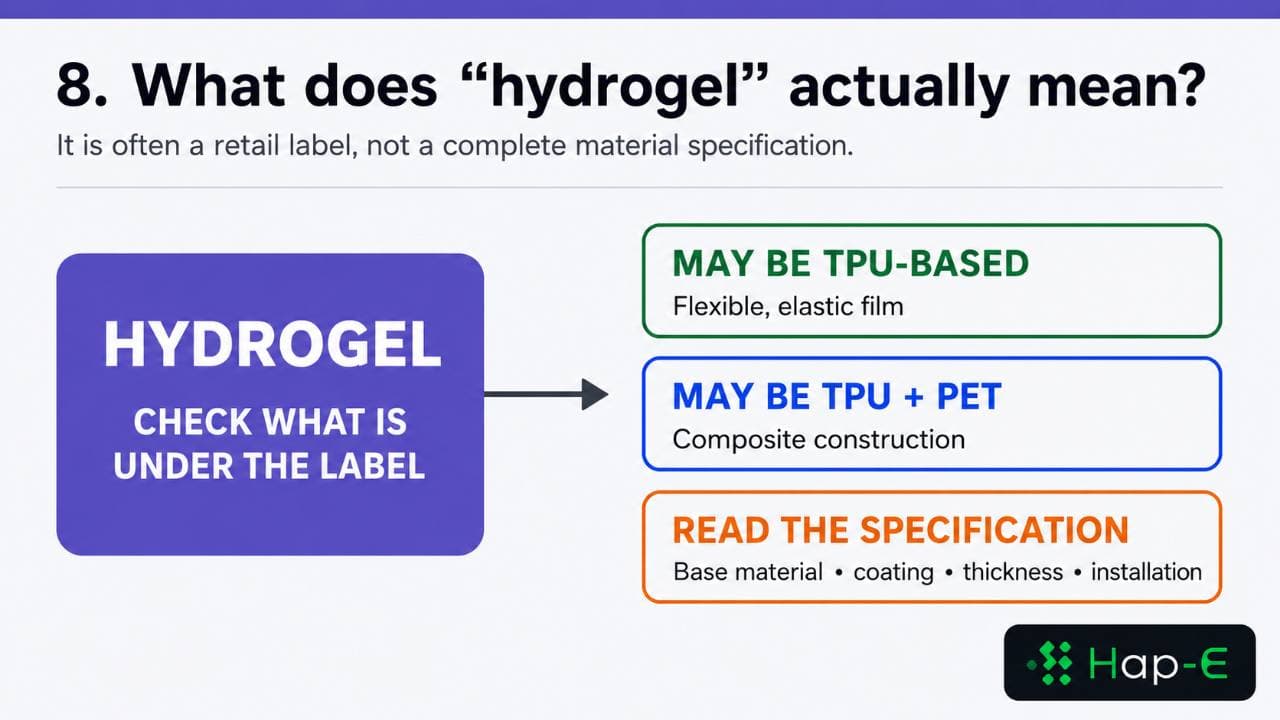
What does hydrogel mean?
In screen-protector listings, hydrogel is often a retail category rather than a complete technical specification. One hydrogel-labelled product may identify its base as soft TPU, while another may use a TPU-and-PET composite. The label is not useless, but it does not tell you enough on its own. Check the base material, coating, thickness, adhesive method, coverage, fingerprint compatibility and exact device model.
Tempered glass vs hydrogel vs TPU vs PET: full comparison
Screen-protector material comparison
Everyday scratch protection
Sharp point impact
Broad blunt impact
Curved-screen fit
Risk of cracking
Fingerprint compatibility
Touch feel
Installation
Fine-mark recovery
Smartwatch suitability
| Criterion | Tempered glass | Hydrogel-labelled film | TPU film | PET film |
|---|---|---|---|---|
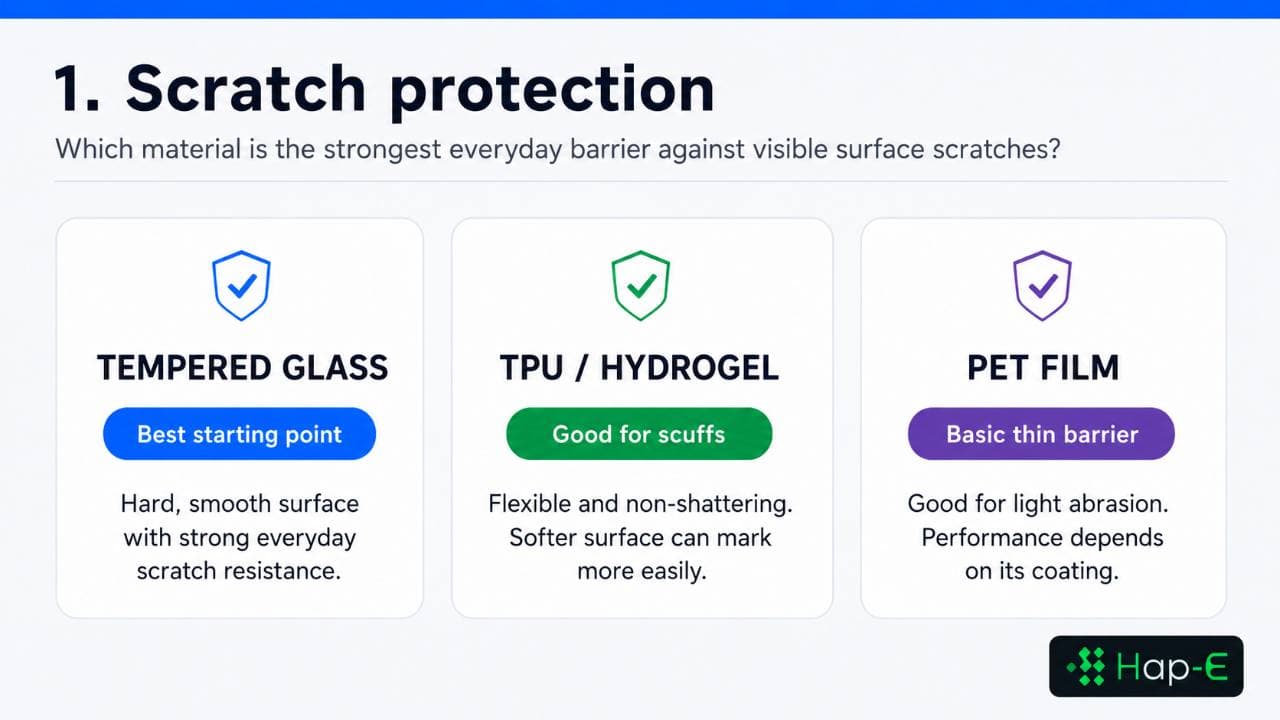
| Everyday scratch protection | Usually strongest | Good for scuffs; deep cuts remain possible | Good against light abrasion; coating dependent | Good when hard-coated; product dependent |
| Sharp point impact | Strongest direct evidence among glass and TPU | Depends on its underlying material | Less protective than glass in the cited sharp-impact tests | Limited direct evidence |
| Broad blunt impact | Good | Potentially good when TPU-based | Comparable to glass in the cited controlled blunt-impact tests | Usually not the main reason to choose PET |
| Curved-screen fit | Product dependent | Excellent | Excellent | Fair to good on gentle curves |
| Risk of cracking | Can crack or chip | Does not shatter like glass | Does not shatter like glass | Does not shatter like glass |
| Fingerprint compatibility | Model and adhesive dependent | Often favourable when thin and fully adhered | Often favourable when thin and fully adhered | Often favourable when thin; still model dependent |
| Touch feel | Closest to bare glass | Smooth to slightly soft | Slightly soft or tacky on some products | Thin and relatively crisp |
| Installation | Easy on flat screens with a tray; harder with UV systems | Moderate | Moderate, often wet-installed | Easy to moderate, commonly dry-installed |
| Fine-mark recovery | No | Product dependent | Product dependent | Normally no |
| Smartwatch suitability | Best on a flat, exact-fit face | Very good | Very good | Suitable for flatter faces |
Which screen protector provides the best scratch protection?
For most buyers, good glass is the strongest starting point when avoiding visible surface scratches is the priority. Its rigid surface is less likely than a soft film to develop dents from fingernails, grit or repeated contact, and it tends to preserve the smooth glide expected from the original display. That does not make every glass protector equal: the coating can wear, edges can chip and hardness claims may use different test methods.
Can hydrogel or TPU heal scratches?
Some TPU products are designed so minor surface impressions become less visible while the film settles. This should be understood as limited surface recovery, not regeneration. A cut through the film, puncture, permanently stretched edge or missing piece of coating will not heal. Do not generalise a self-healing claim from one product to every TPU or hydrogel-labelled protector.
Where PET fits
Hard-coated PET can provide effective everyday scratch protection while adding very little thickness. It is especially useful for matte and anti-glare finishes. Its limitation is that it cannot cushion deformation in the same way as elastic TPU and does not add the rigid sacrificial layer of glass. Choose it as a slim surface barrier rather than maximum physical protection.
Shop this product
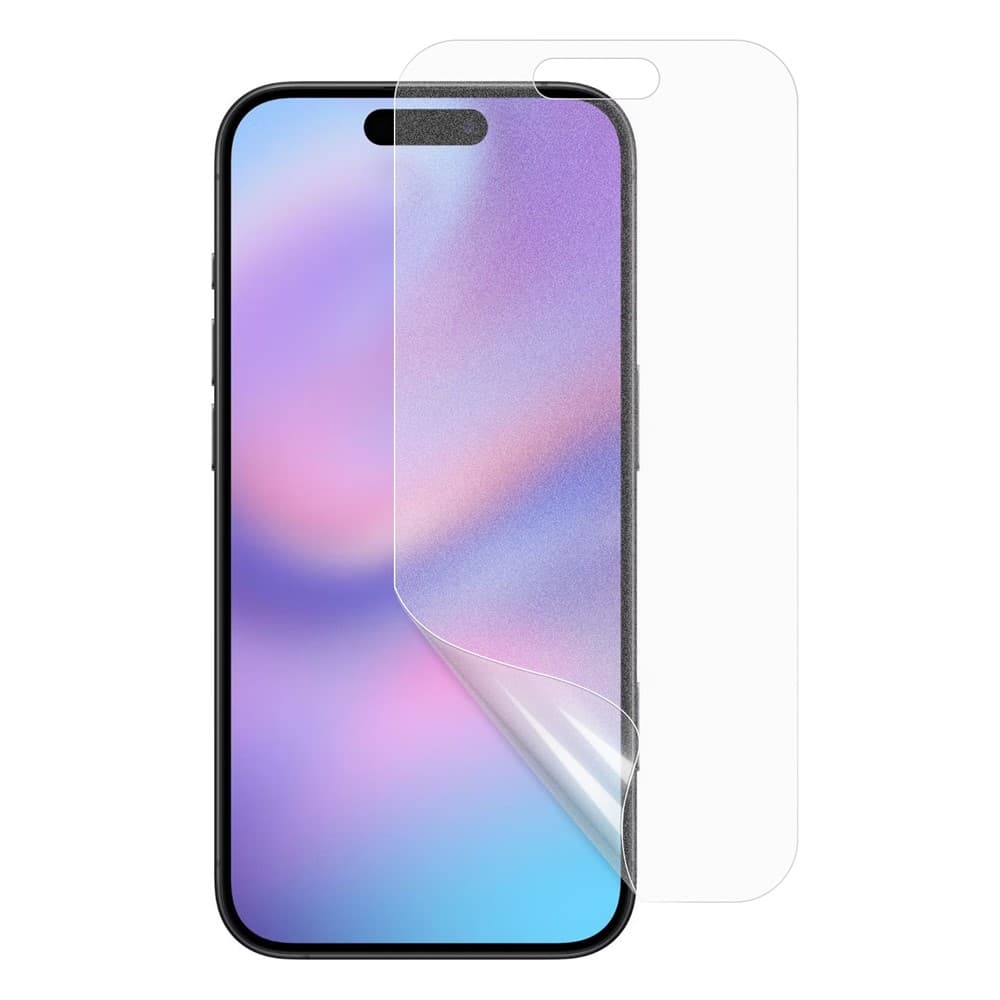
iPhone 17 Matte Screen Protector Anti-Fingerprint Soft PET Screen Film
R 130
View productWhich material provides the best impact resistance?
Impact resistance is not one characteristic. A narrow point concentrates force into a small area; a broad object distributes force over a larger one. A 2026 peer-reviewed study comparing chemically strengthened glass and TPU protectors found that glass performed better under sharp impacts because of its stiffness, while TPU provided comparable protection under blunt impacts in the tested conditions. Thickness and stiffness also affected the results.
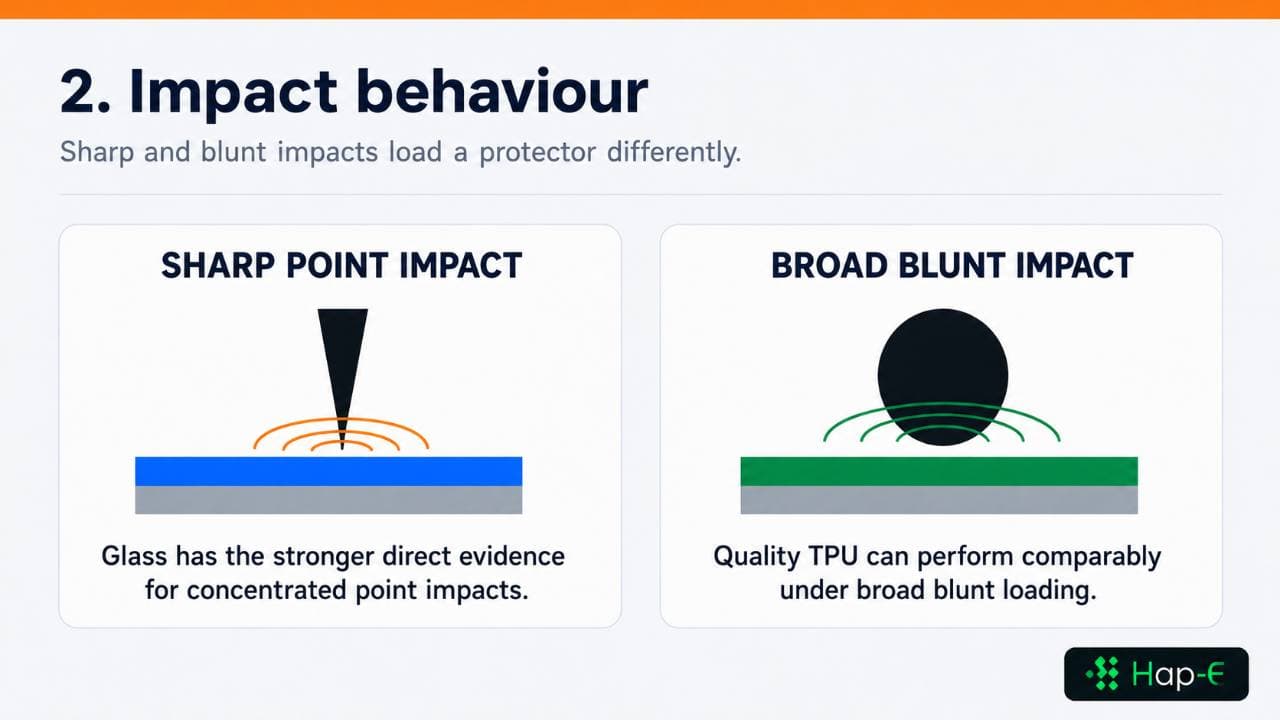
Pair the protector with a correctly fitted case that has a raised screen edge. A protector cannot fully guard the frame, camera lenses, phone-bending loads, an exposed curved edge or internal damage caused by sudden acceleration. A cracked protector also does not prove exactly how much force reached the screen beneath it.
Which screen protector works best on a curved screen?
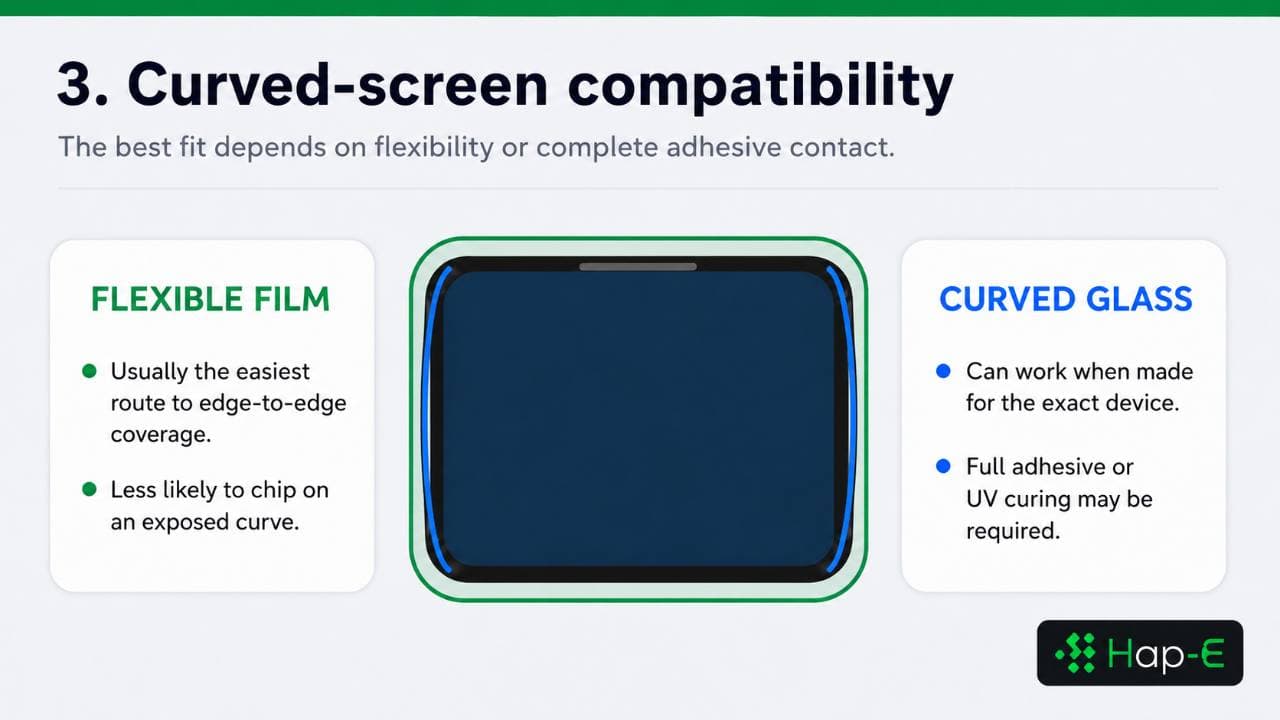
Flexible TPU or hydrogel-labelled film is usually the simplest recommendation for a strongly curved display. It can follow the screen shape without forcing a rigid sheet over the curve, cover more of the viewing area and avoid an exposed glass lip that may chip. The trade-offs are a softer surface, lower resistance to deep cuts and possible lifting if a case pushes against the film.
Can tempered glass fit a curved display?
Yes, provided it is designed for the exact device. Curved-glass systems may use a full layer of liquid optical clear adhesive rather than relying on adhesive only at the border. Some spread liquid adhesive beneath the glass and cure it with ultraviolet light. This can provide broad contact and retain a glass surface, but alignment, liquid control and curing make installation more complex. Poor installation can cause unbonded areas, rainbow effects, touch dead zones, sensor problems or adhesive leakage.
Shop this product
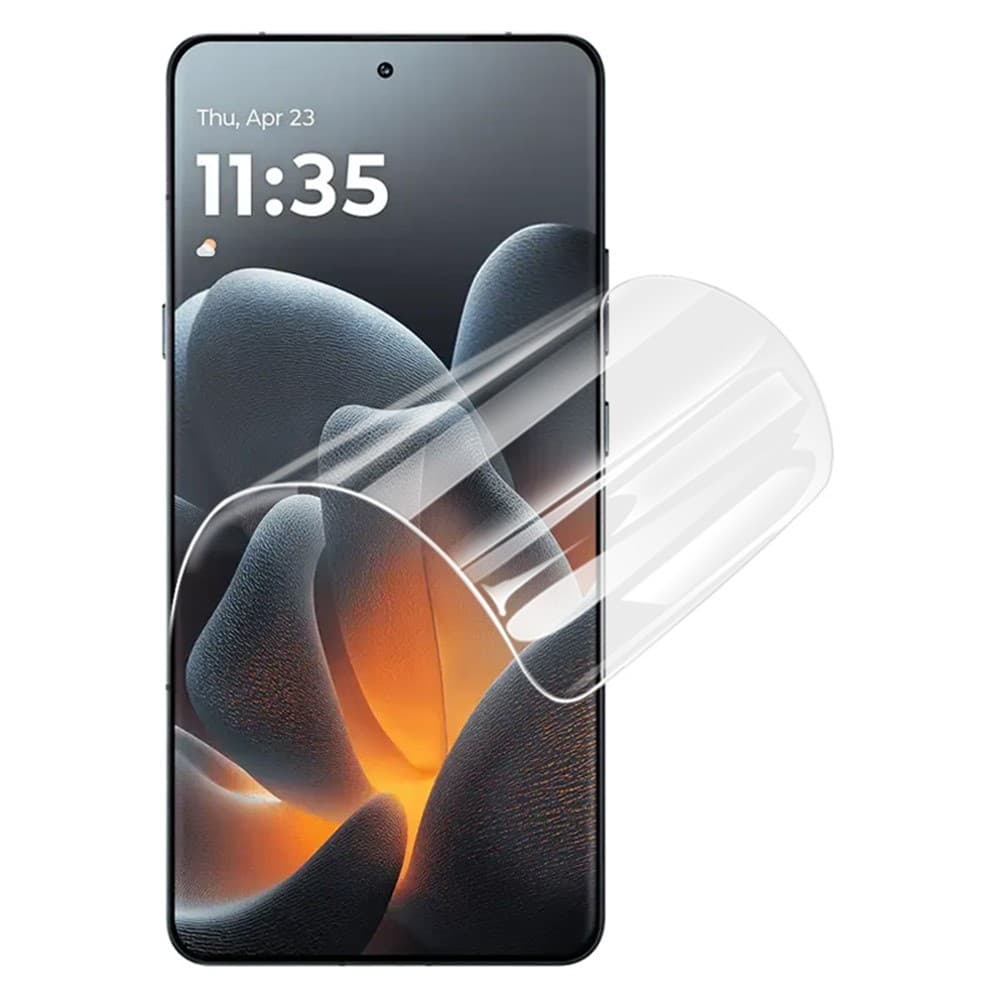
IMAK Hydrogel Film 4th For Motorola Edge 70 Ultra 5G / Moto X70 Air Pro 5G / Signature 5G Full Screen Protector Ultra Clear Full Glue Soft TPU Film
R 205
View productWhich protector works best with an in-display fingerprint reader?
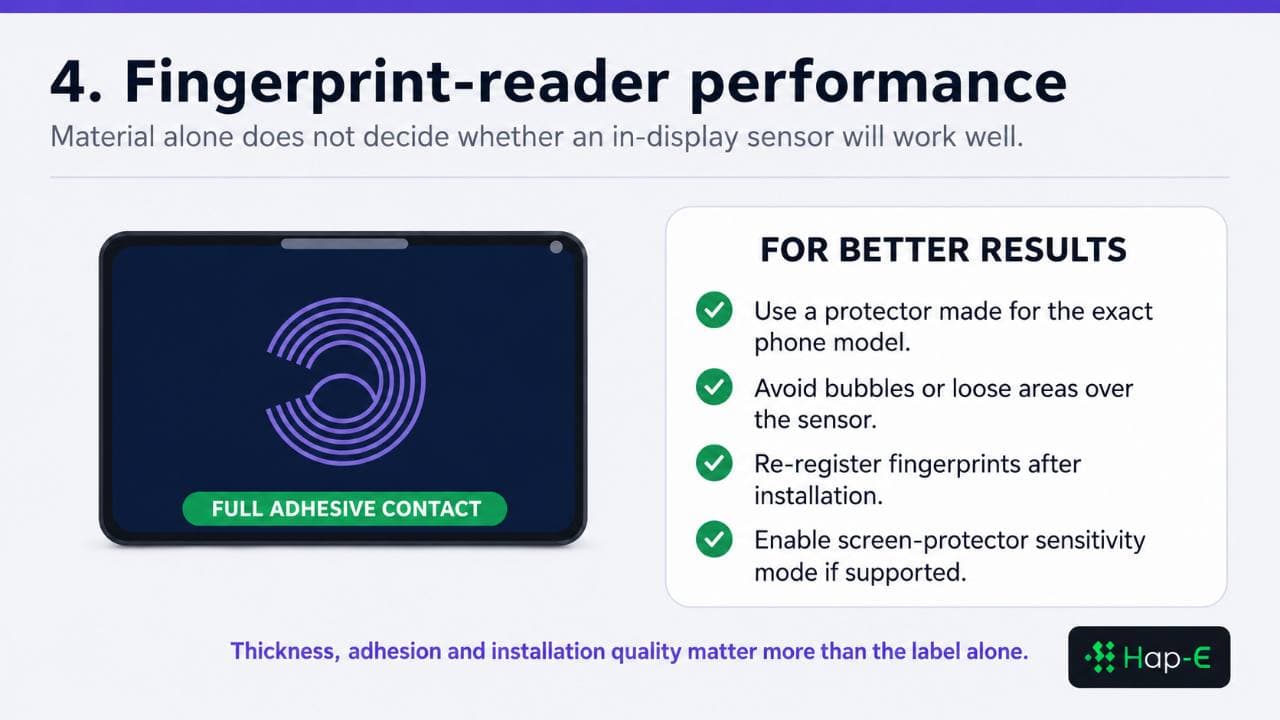
There is no material-only winner. A thin flexible film may place less material above the sensor, but an approved glass protector can also work. The decisive factors are the exact phone model, sensor technology, protector thickness, complete adhesive contact, absence of bubbles, surface cleanliness and installation accuracy. Google recommends compatible, model-specific protectors and warns that bubbles can impair fingerprint recognition.
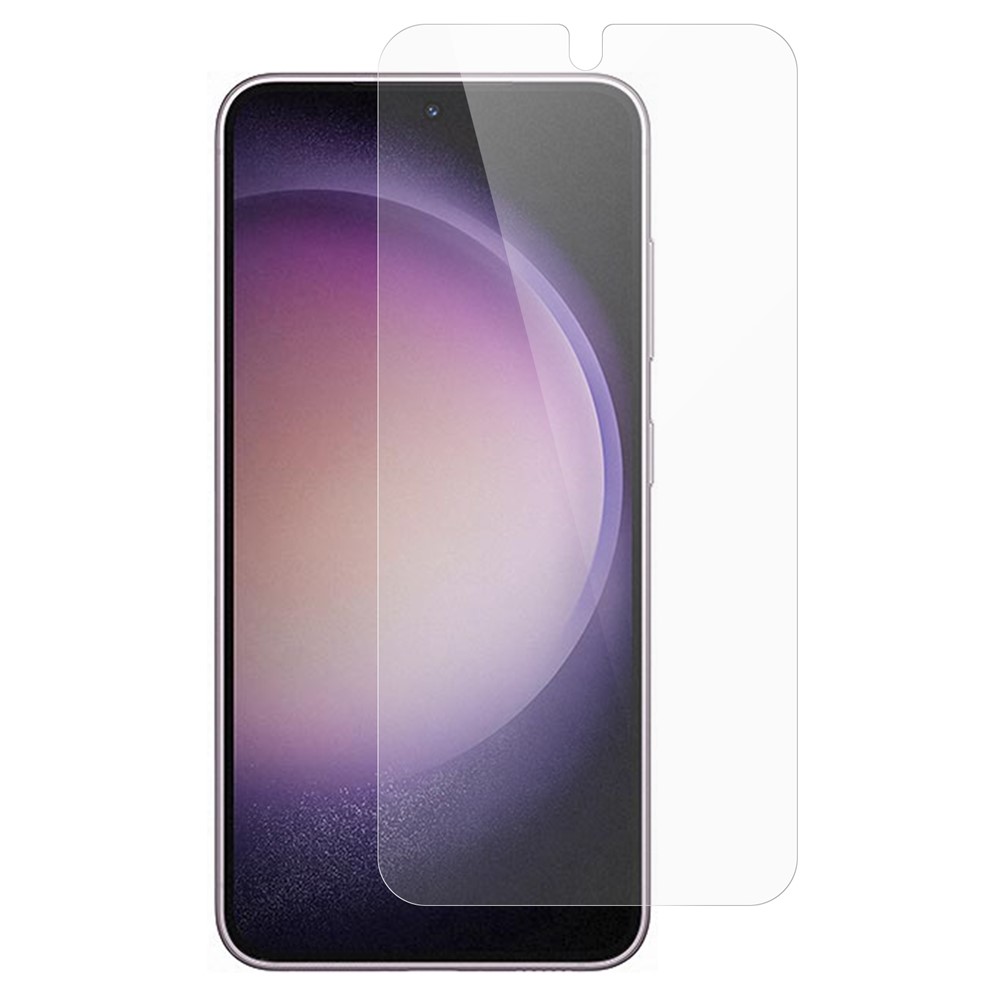
Shop this product
Samsung Galaxy S24 Ultra Tempered Glass 0.18mm Ultra-thin Screen Protector (Fingerprint Unlock)
R 165
View productWhich material is easiest to install?
The application system can matter as much as the material. Glass supplied with an alignment tray may be easier than flexible film with no positioning frame. Dry PET can be simple until a dust particle is trapped beneath it. Wet TPU allows repositioning but takes time to settle. Full-adhesive UV glass demands the most care.
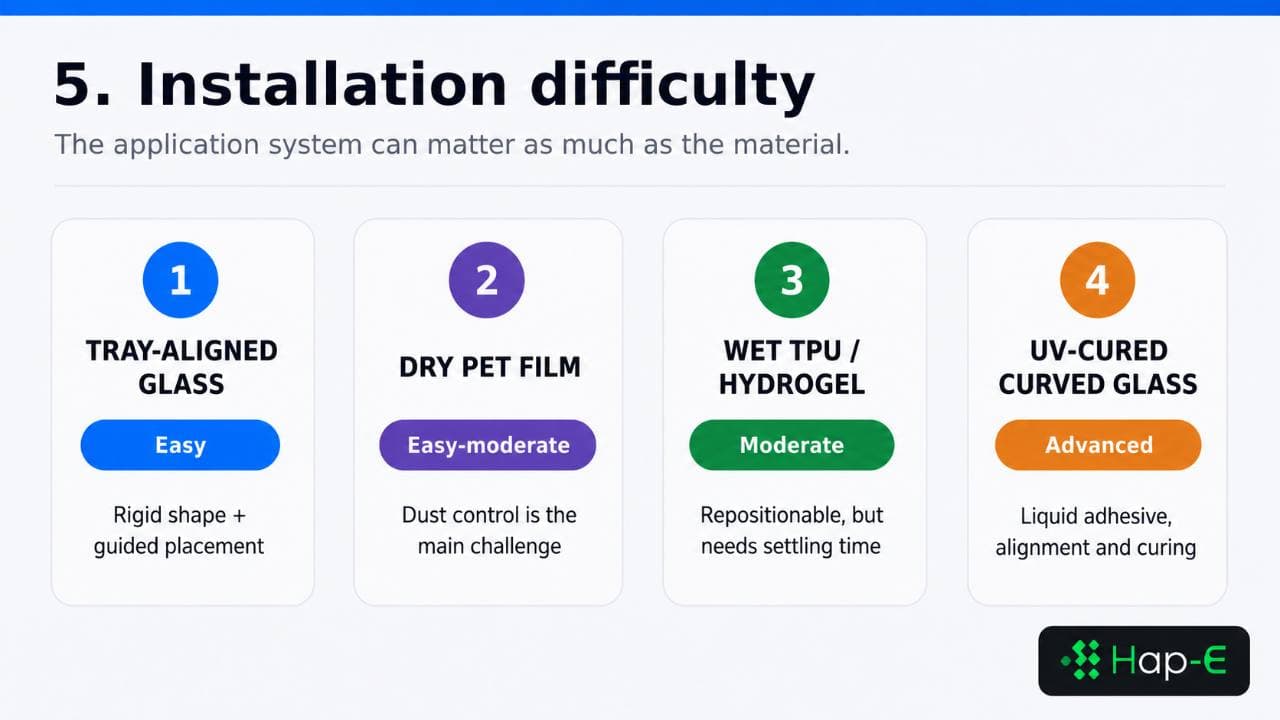
Screen-protector installation difficulty
Flat glass with alignment tray
Flat glass without a tray
Dry-installed PET
Wet-installed TPU or hydrogel
Curved full-adhesive glass
UV-cured curved glass
Small smartwatch film
| Protector type | Relative difficulty | Common challenge | After fitting |
|---|---|---|---|
| Flat glass with alignment tray | Easy | Dust and final alignment | Usually ready immediately |
| Flat glass without a tray | Easy to moderate | Crooked placement | Usually ready immediately |
| Dry-installed PET | Easy to moderate | Dust and static attraction | Ready immediately |
| Wet-installed TPU or hydrogel | Moderate | Liquid control, stretching and edge alignment | May need settling time |
| Curved full-adhesive glass | Moderate to difficult | Complete adhesive contact | Follow the stated setting time |
| UV-cured curved glass | Difficult | Adhesive volume, port protection and curing | Complete the full curing sequence |
| Small smartwatch film | Moderate | Tiny alignment errors are highly visible | Edges may need extra setting time |
Flat tempered glass
Glass does not stretch, so its shape is predictable. A good alignment frame can make a flat-phone installation straightforward. Control dust, avoid touching the adhesive, centre the protector and confirm that the case will not press against its edges.
Wet-installed TPU or hydrogel film
Flexible film can often be repositioned during wet installation, but it can stretch if pulled. Haze, moisture and small impressions may remain temporarily while it settles. Follow the timing supplied with that product instead of applying another brand's curing claim to it.
Dry PET and UV-cured glass
PET is commonly installed dry. Its dimensional stability helps it keep its shape, but the thin sheet can attract dust or crease if handled carelessly. UV-cured glass is the least beginner-friendly approach: liquid adhesive must be controlled, openings protected, alignment checked and the full curing sequence completed.
Which material has the best touch sensitivity?
Tempered glass normally provides the most natural finger glide because the contact surface is glass. That does not guarantee the best electronic response: excessive thickness, an air gap, loose edge or incomplete adhesive layer can reduce responsiveness. TPU is thin and responsive but may feel softer or tackier. PET feels crisp and thin; matte PET intentionally diffuses light and has a different glide.
How frequently should a screen protector be replaced?
Do not replace a protector merely because a fixed number of months has passed. Replace it when its condition prevents it from protecting the display or interferes with use. Regular visual inspection is more useful than an arbitrary calendar.
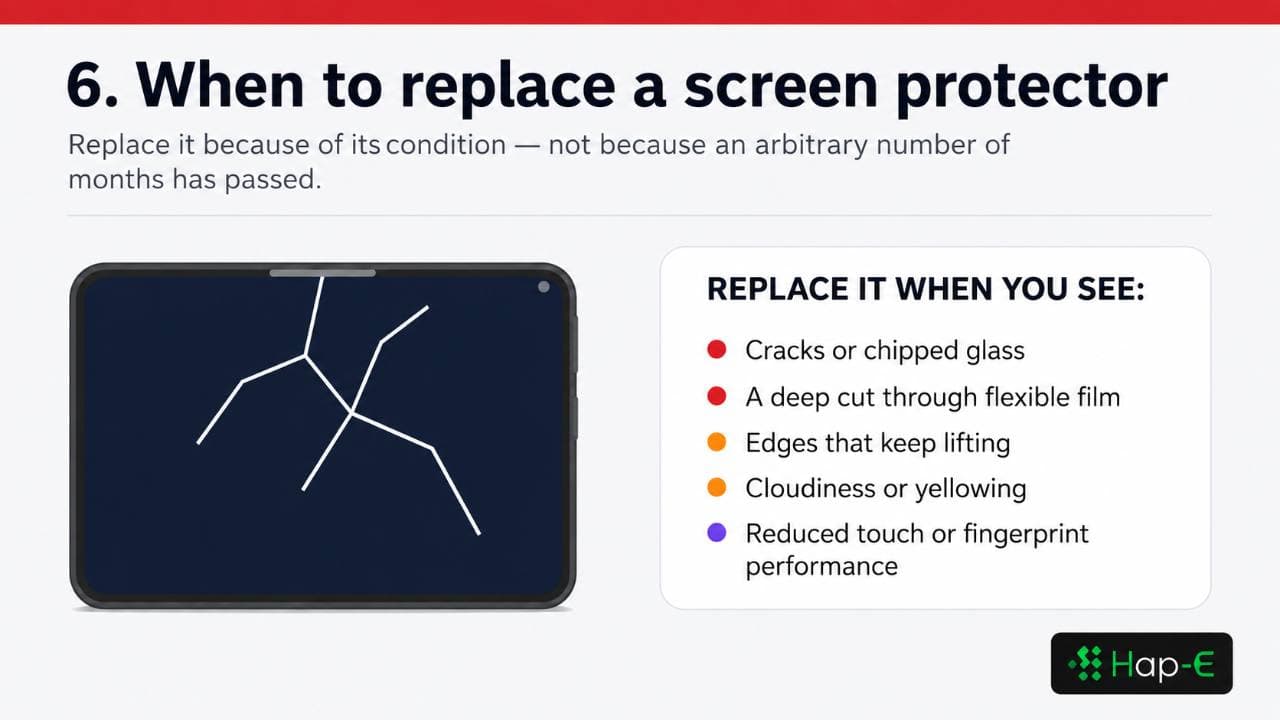
Screen-protector replacement triggers
Tempered glass is cracked or chipped
Protector slides or has detached areas
Permanent bubble over fingerprint sensor
TPU or hydrogel has a deep cut
Film is yellow, cloudy or hazy
Edges repeatedly lift
Fine cosmetic marks only
Fingerprint recognition has deteriorated
| Condition | Replace now? | Reason |
|---|---|---|
| Tempered glass is cracked or chipped | Yes | Damage can spread and expose sharp edges |
| Protector slides or has detached areas | Yes | Adhesive contact and protection are compromised |
| Permanent bubble over fingerprint sensor | Yes, if refitting cannot resolve it | Recognition may be impaired |
| TPU or hydrogel has a deep cut | Yes | A cut through the film will not self-heal |
| Film is yellow, cloudy or hazy | Usually | Display clarity is reduced |
| Edges repeatedly lift | Usually | Dirt and moisture can collect beneath the film |
| Fine cosmetic marks only | Not necessarily | Continue if clarity and touch remain acceptable |
| Fingerprint recognition has deteriorated | Inspect and clean first | Replace if scratches or detachment remain the cause |
Phone versus smartwatch screen protection
Flat-screen smartphones
Tempered glass is the default recommendation for most conventional flat phones. It offers a familiar touch surface, strong everyday scratch resistance and better direct evidence against sharp point impacts than TPU. Choose exact model coverage, suitable case clearance, complete adhesive contact and a reliable alignment method.
Curved-screen smartphones
Flexible TPU or hydrogel film is normally the easiest route to broad curved coverage. A correctly designed UV-glass system can retain the feel of glass, but asks more of the installer. If you change cases, check that the new case will not push against the protector.
Smartwatches
Watch screens are small, exposed and often curved near the edge. Flexible TPU or a TPU/PET composite is therefore a strong practical choice: it conforms to rounded glass, adds little thickness and does not form a rigid shard when damaged. Exact-fit glass can still suit a flat watch face, while PET works where the priority is a very thin scratch barrier.
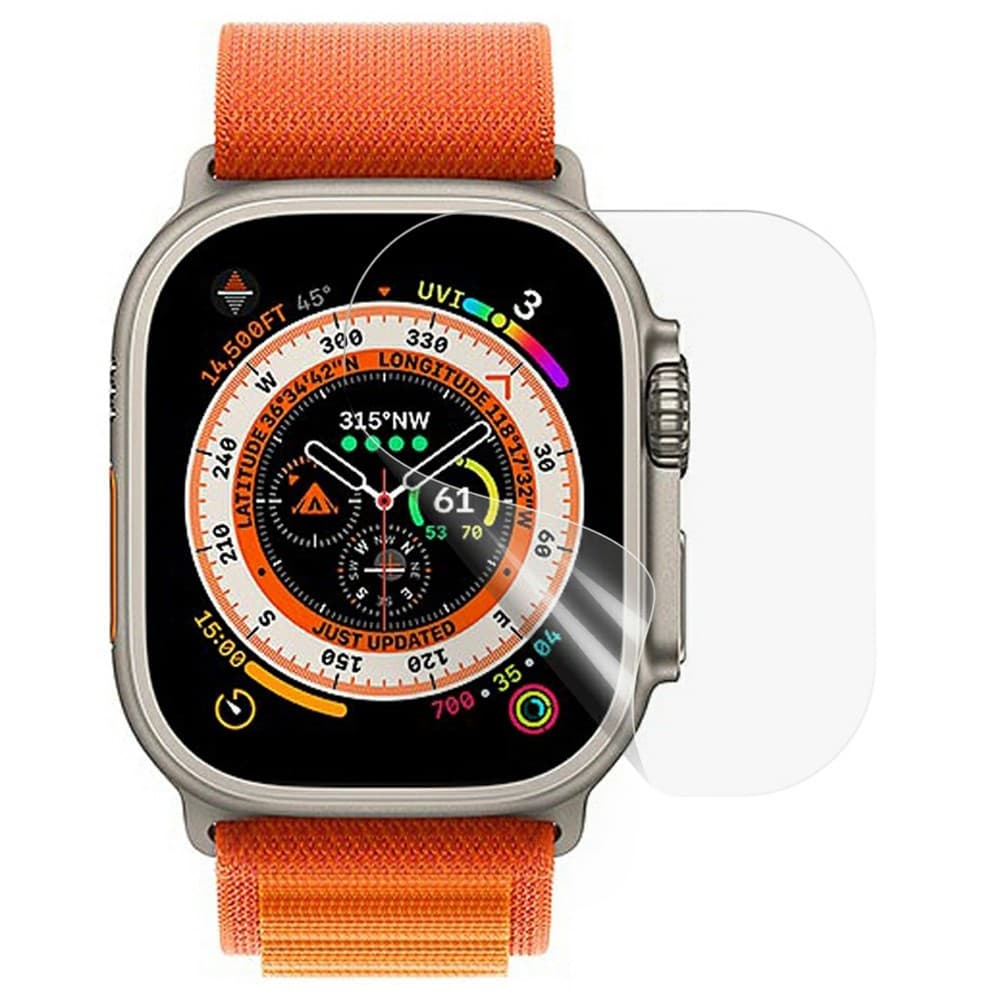
Shop this product
Apple Watch Series 11 46mm / 10 46mm Screen Protector Anti-Scratch TPU+PET Ultra Clear Hydrogel Watch Film
R 135
View product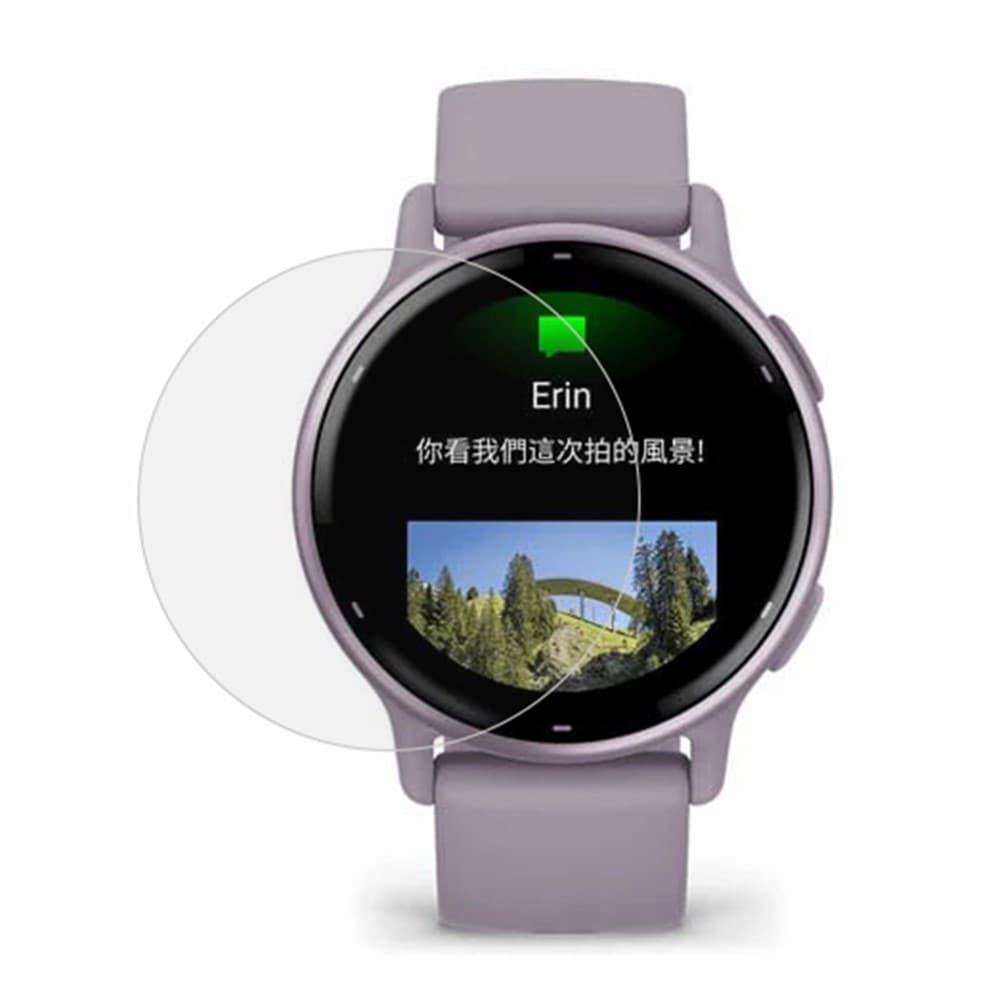
Shop this product
Garmin Vivoactive 6 / vivoactive 5 Full Screen Protector HD Clear Anti-Explosion TPU Watch Film
R 125
View productFoldable phones
A folding phone has two protection questions. The conventional outer display can usually use a model-specific protector. The flexible inner display is different because its protective layer forms part of a system that repeatedly bends. The device manufacturer's instructions take priority.
Final recommendations by use case
Which screen protector should you buy?
Standard flat-screen phone owner
Strongly curved display owner
Curved display owner wanting glass feel
In-display fingerprint user
Outdoor worker carrying tools
Matte-display enthusiast
Minimalist avoiding extra thickness
Smartwatch owner
Foldable inner-screen owner
| User or device | Recommended choice | Why |
|---|---|---|
| Standard flat-screen phone owner | Model-specific tempered glass | Best all-round balance of scratch protection and natural touch |
| Strongly curved display owner | TPU or hydrogel-labelled flexible film | Better conformity and edge coverage |
| Curved display owner wanting glass feel | Professionally fitted or carefully installed full-adhesive glass | Retains a glass surface while addressing curved contact |
| In-display fingerprint user | Certified or explicitly compatible protector | Sensor compatibility matters more than the category name |
| Outdoor worker carrying tools | Quality glass plus a raised-edge case | Stronger sharp-point impact evidence and broader device coverage |
| Matte-display enthusiast | Matte PET or matte film | Thin anti-glare surface |
| Minimalist avoiding extra thickness | PET or ultra-thin compatible film | Low-profile surface protection |
| Smartwatch owner | TPU, hydrogel or TPU/PET composite | Conforms to a small curved face without shattering |
| Foldable inner-screen owner | Manufacturer-approved service process | Reduces the risk of damaging the folding system |
Frequently asked questions
Is hydrogel better than tempered glass?
Not universally. Hydrogel-labelled flexible film is usually better for curved coverage and resistance to shattering, while glass normally provides stronger scratch resistance, a more natural touch surface and better evidence against sharp point impacts. The better choice depends on the device and risk.
Is hydrogel the same as TPU?
Sometimes, but not always. Hydrogel may label a soft TPU film or a composite such as TPU and PET. Read the actual material specification, thickness, coating and installation method.
Does hydrogel protect a phone from drops?
A TPU-based hydrogel film may help under some broad blunt loading, but it cannot guarantee that the display will survive a drop. Controlled research found TPU comparable to glass for blunt impacts in its test conditions, while glass performed better against sharp impacts.
Which protector is hardest to scratch?
Quality glass generally provides the strongest scratch-resistant surface among these categories. Coatings and test methods vary, and a 9H pencil rating should not be mistaken for Mohs hardness 9.
Which protector works best with a fingerprint reader?
Use a model-specific or manufacturer-certified protector. Thin film often works well, but compatible glass can also work. Thickness, complete adhesive contact, bubbles and installation quality matter more than the category alone.
Can tempered glass fit a curved phone?
Yes, if it is designed for the exact curve and uses an appropriate adhesive system. Full-adhesive or UV-cured glass can cover curved displays, but it is more difficult to install than flexible film.
Do bubbles disappear from a hydrogel protector?
Some moisture or small installation marks may clear as a wet-installed film settles, but trapped dust and large air pockets can remain. Follow the product-specific settling instructions before lifting or replacing the film.
How often should tempered glass be replaced?
Replace it when it cracks, chips, lifts, becomes difficult to see through or interferes with touch or fingerprint recognition. An undamaged protector does not need replacement solely because a fixed period has passed.
Is glass or film better for a smartwatch?
Flexible film is usually more practical for a curved watch face because it conforms closely and cannot shatter. Exact-fit glass may be preferable on a flat watch face when scratch resistance and a glass-like surface are the priorities.
The final buying rule
There is no single protector that leads every category. Tempered glass is the best general recommendation for most flat-screen phones. TPU or a clearly specified hydrogel film is normally better for strongly curved screens and smartwatches. PET is the practical minimalist option when thinness, price or a matte finish matters most.
Before ordering, look past broad claims such as “unbreakable”, “explosion-proof” or “universal”. Check the exact device model, base material, adhesive coverage, fingerprint compatibility, case clearance and installation method. The right protector is not simply the hardest one: it is the one that fits correctly, preserves the features you use and addresses the damage your device is most likely to encounter.
Sources and editorial note
Research and product information checked on 21 July 2026. The impact discussion is based on the 2026 peer-reviewed study “Impact testing of screen protectors for mobile devices”. Fingerprint guidance follows Google Pixel and Samsung support advice. Material guidance draws on primary manufacturer information. Product features are attributed to their listings and are not independent HAP laboratory tests.
- Aalborg University Research Portal: Impact testing of screen protectors for mobile devices — https://vbn.aau.dk/en/publications/impact-testing-of-screen-protectors-for-mobile-devices/
- Google Pixel Help: Use screen protectors with Fingerprint Unlock — https://support.google.com/pixelphone/answer/16048560?hl=en
- Google Pixel Help: Fix fingerprint sensor issues — https://support.google.com/pixelphone/answer/13537318?hl=en-GB
- ISO 15184: Paints and varnishes — Determination of film hardness by pencil test — https://www.iso.org/standard/76074.html
- Samsung Support: follow the exact device guidance for fingerprint sensors, touch sensitivity and foldable displays — https://www.samsung.com/za/support/
Found this helpful?
Share it with someone who may need it.