
Jump to a section
Selling on Takealot can put your products in front of an established South African marketplace audience—but opening an account is the easy part. The real work is choosing products that can survive fees and returns, preparing accurate catalogue data, controlling stock, and protecting cash flow.
How selling on Takealot works
Think of the journey as four connected jobs: prove the product can make money, become an approved seller, build an accurate catalogue, and operate the account consistently. If one job is weak, the others usually become expensive.
- Research demand, competition, compliance and supplier reliability.
- Model landed cost, marketplace charges, returns, stock preparation and overhead.
- Prepare the seller documents and apply through the official seller page.
- Complete Seller Portal onboarding and decide how each product will be fulfilled.
- Match an exact existing catalogue page or create a new listing with accurate data.
- Prepare stock, launch a focused range, reconcile payouts and learn from returns.
R400 monthly subscription per seller account, exclusive of VAT
Success, fulfilment and storage fees may also apply
Seller payouts advertised four times per month
Approval is not automatic
| Current public detail | What it means for your plan |
|---|---|
| R400 monthly subscription per seller account, exclusive of VAT | Allocate the account fee across realistic monthly sales; low volume makes the fee heavier per unit. |
| Success, fulfilment and storage fees may also apply | Use the current official Fee Estimator and Seller Portal figures for each SKU. |
| Seller payouts advertised four times per month | You still need cash to fund stock, freight, VAT and replenishment between payout cycles. |
| Approval is not automatic | Account approval and product-listing approval remain separate marketplace decisions. |
These details were checked against Takealot’s public seller information on 16 July 2026. Fees, workflows and terminology can change, so treat the Seller Portal and official tools as the final authority.

Is it worth selling on Takealot?
It can be a useful channel when you have a dependable supplier, a product customers actually want, enough margin to absorb the full cost stack, and the discipline to monitor stock and account performance. It is not guaranteed passive income.
Demand is visible from several sources
Margin remains positive in a downside scenario
The supplier and sample have been tested
The item is easy to describe and fulfil
You can explain why a shopper should choose you
| A healthier fit | A warning sign |
|---|---|
| Demand is visible from several sources | The idea depends on one viral post or a guess |
| Margin remains positive in a downside scenario | A small discount makes the item loss-making |
| The supplier and sample have been tested | Stock quality or future availability is uncertain |
| The item is easy to describe and fulfil | Compatibility, sizing or damage risk is high |
| You can explain why a shopper should choose you | The only strategy is to be the cheapest |
Phase 1: Prove the idea before you apply
This phase protects you from the most expensive beginner mistake: getting excited about an account before proving that the product economics work.
Step 1: Choose a product with workable economics
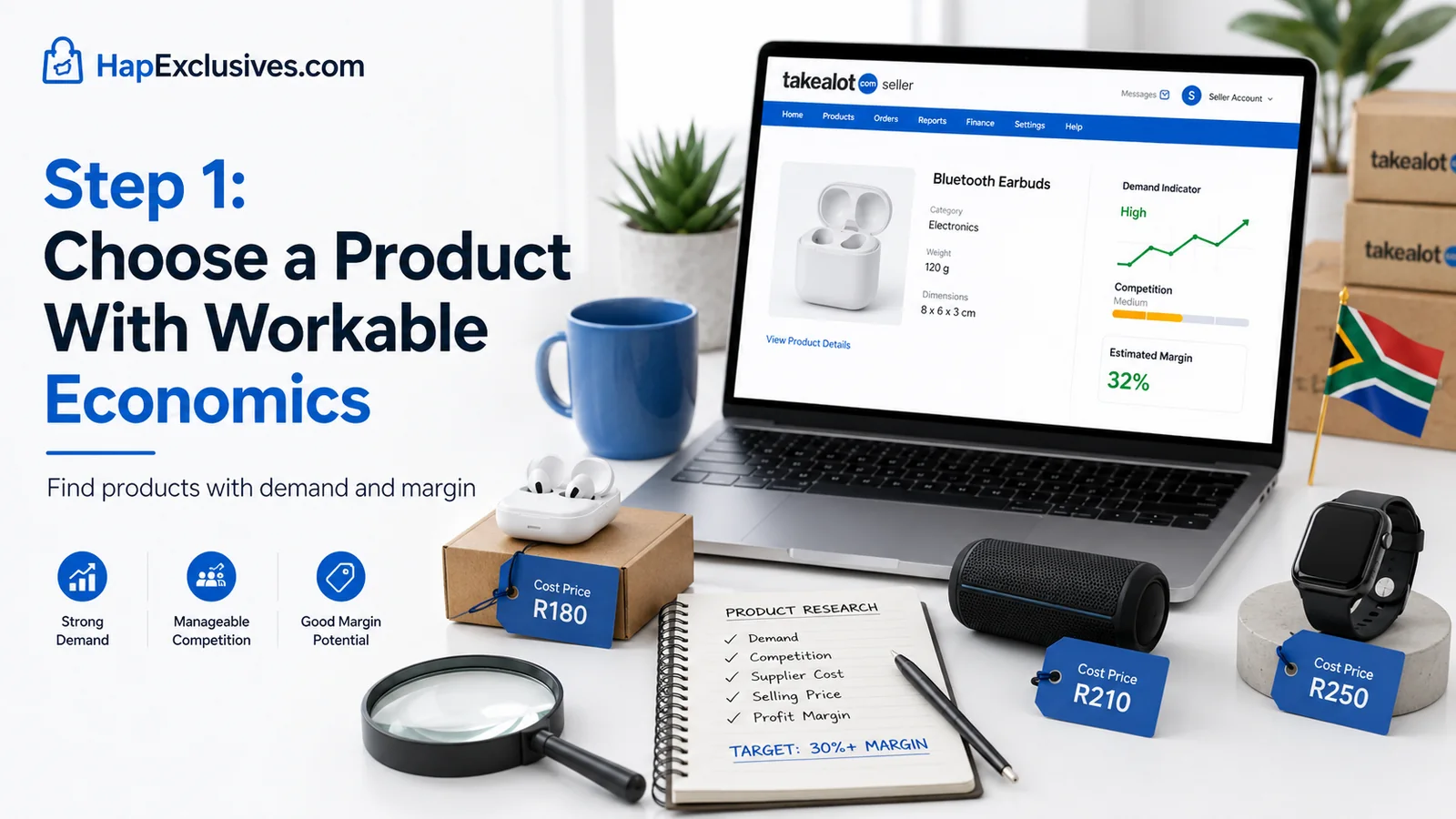
A fast-selling product can still lose money. Screen every idea using eight lenses before placing a meaningful purchase order.
- Demand: use several signals—existing offers, accepted price points, search behaviour, reviews and demand from your own channels.
- Competition: record realistic prices, seller count, delivery estimates, listing quality and how often competitors discount.
- Landed cost: include the supplier, freight, insurance, customs duty, import VAT, clearing, local delivery, inspection, packaging and damage allowance.
- Marketplace charges: allow for the subscription, success fees, fulfilment, storage, returns, promotions and VAT on applicable charges.
- Packaged size and weight: measure a ready-to-ship sample, not the naked product.
- Return risk: look for sizing, colour, compatibility, installation, fragility and missing-accessory problems.
- Supplier reliability: test samples, lead times, defect rates, packaging, replacement policy and document quality.
- Differentiation: use a useful bundle, clearer information, better packaging, local availability, defensible branding or a real warranty advantage.
Demand evidence
Margin potential
Competition
Return risk
Fulfilment
Supplier
Compliance
Differentiation
| Score from 1 to 5 | 1 means | 5 means |
|---|---|---|
| Demand evidence | Little evidence | Several credible signals |
| Margin potential | Very thin | Comfortable buffer after all costs |
| Competition | Hard to defend | A clear gap or advantage |
| Return risk | High | Low and controllable |
| Fulfilment | Bulky or fragile | Small, light and simple |
| Supplier | Unproven | Tested and dependable |
| Compliance | Unknown | Documents and approvals ready |
| Differentiation | Generic commodity | Meaningful customer benefit |
Step 2: Calculate real profit before applying
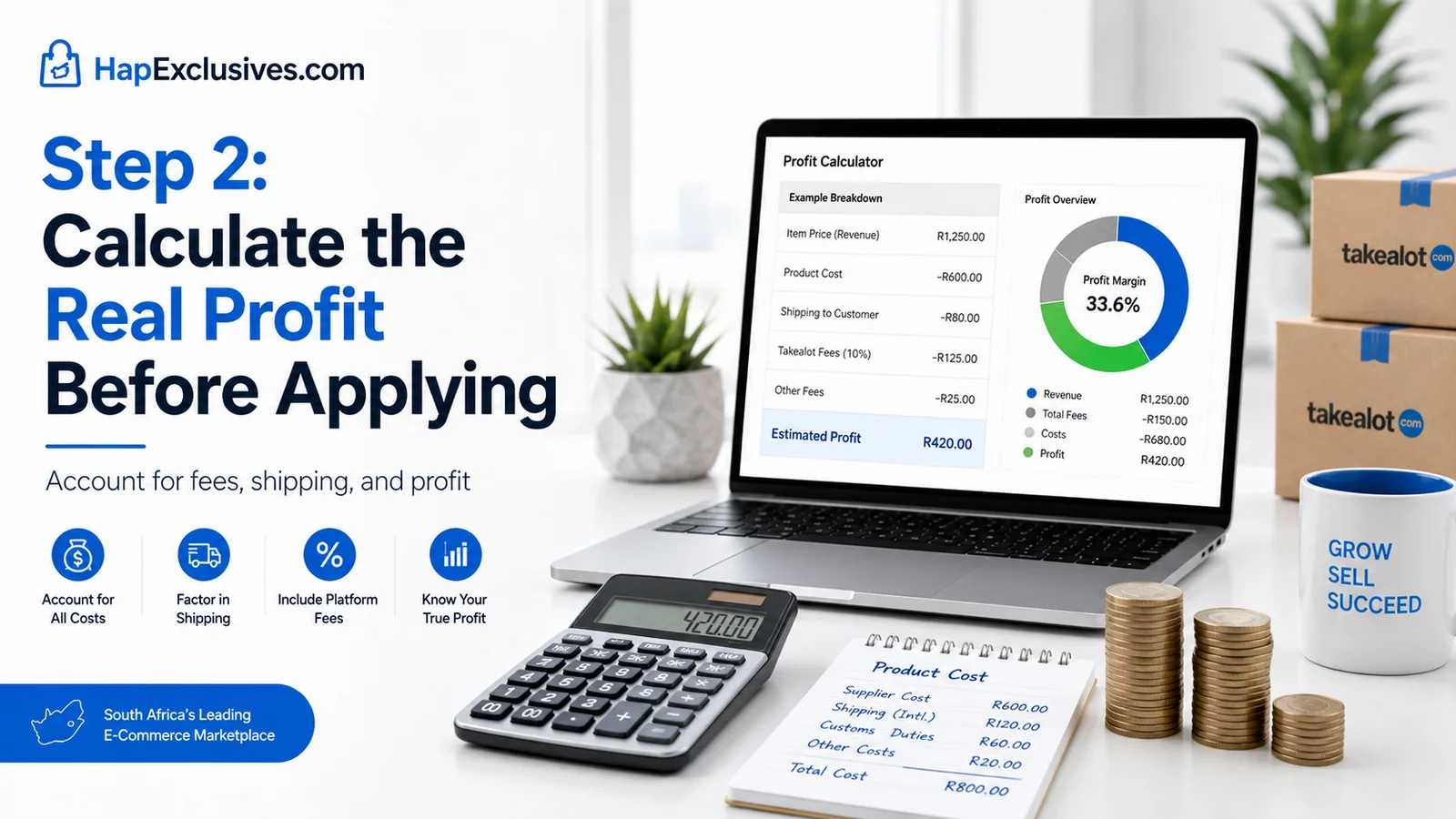
“Contribution per unit = selling price − landed cost − marketplace charges − stock preparation − returns allowance − advertising allowance − allocated overhead”
Contribution is what remains before income tax and broader business expenses. It is more useful than simply subtracting supplier cost from selling price.
Selling price
Landed product cost
Estimated marketplace charges
Packaging and inbound preparation
Returns and promotion allowance
Monthly account allocation
Estimated contribution
| Illustrative R499 sale | Amount |
|---|---|
| Selling price | R499 |
| Landed product cost | −R185 |
| Estimated marketplace charges | −R95 |
| Packaging and inbound preparation | −R22 |
| Returns and promotion allowance | −R35 |
| Monthly account allocation | −R10 |
| Estimated contribution | R152 |
The example is a planning scenario, not a Takealot fee quote. Run it again with a 10% lower selling price, a weaker rand, higher returns, slower sales and a competitor matching your product.
Step 3: Prepare your seller documents
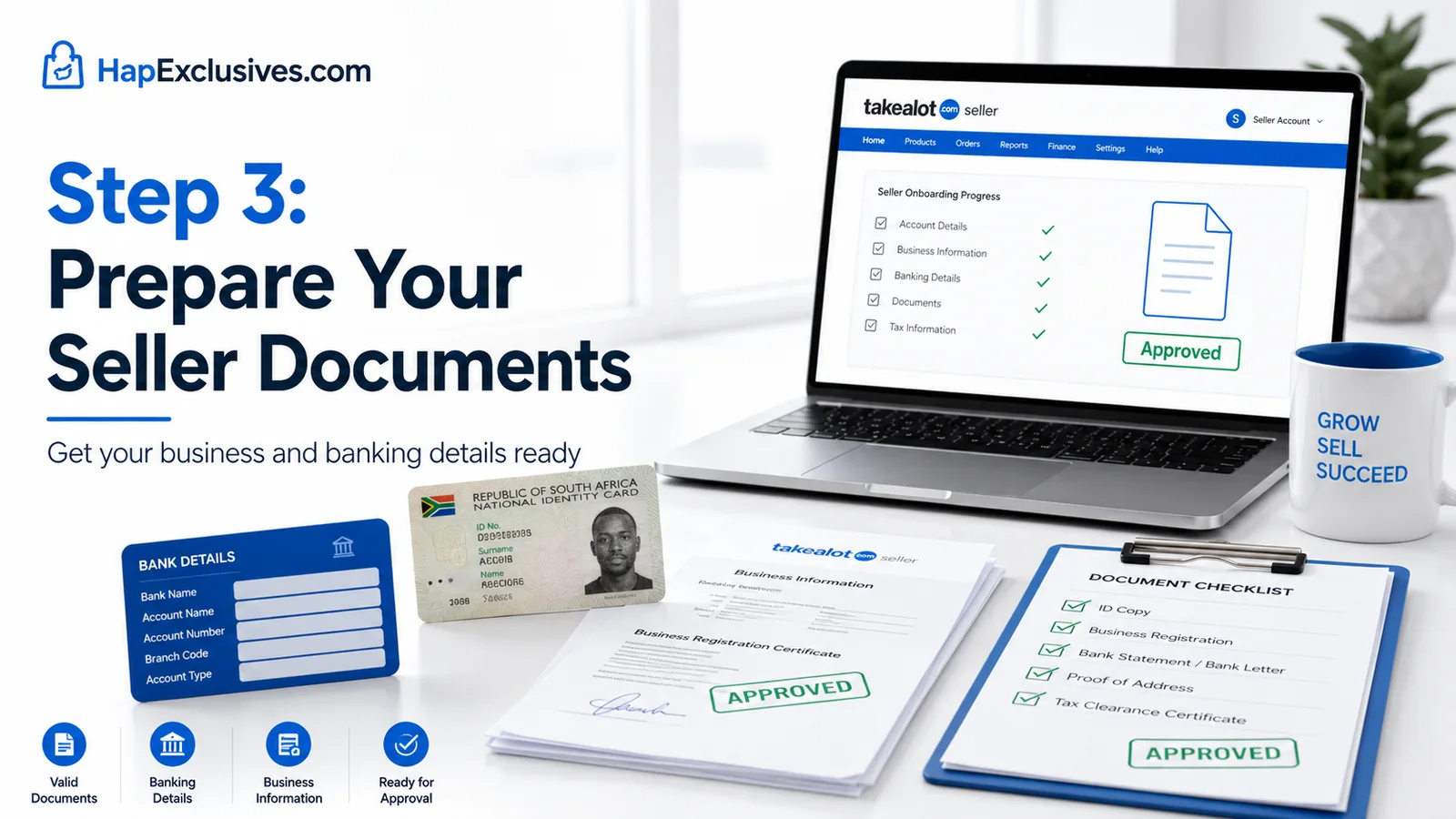
Exact requirements depend on the application type and can change. Common preparation items include:
- South African identity document or passport and current contact details.
- Proof of address and bank-account evidence in the appropriate name.
- Business-registration records and VAT details where applicable.
- A clear description of the business, intended categories and supplier relationship.
- Product, catalogue, invoice or compliance information that supports what you intend to sell.
Step 4: Apply for a seller account
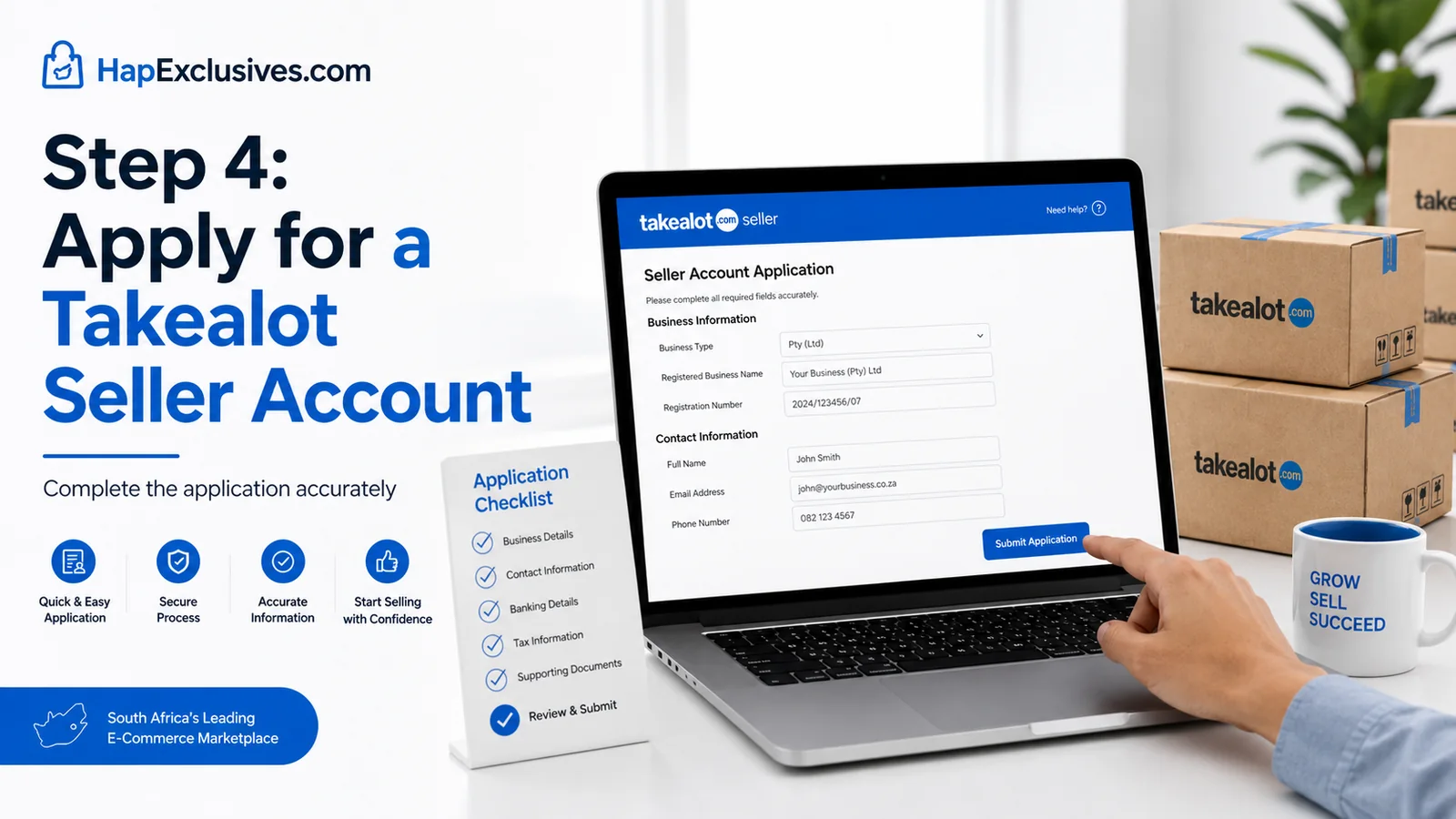
Use Takealot’s official seller application. Describe the person or business, categories, supplier or brand relationship, current sales activity and expected operation accurately. Do not inflate turnover or claim rights you cannot prove.
Phase 2: Build a clean account and catalogue
Once approved, your Seller Portal becomes the operating centre for products, offers, stock, fulfilment, sales, returns, payouts and account health.
Step 5: Complete Seller Portal setup
Work through the current onboarding material before creating products. Write down who changes prices, monitors stock, approves listings, prepares units, reviews returns, reconciles payouts and handles account warnings—even if every role is currently you.
Step 6: Match the exact catalogue product—or do not match it
Use an existing product page only when the brand, model, colour, size, pack quantity, barcode, specifications, contents and warranty arrangement are genuinely identical.
- Do not attach an unbranded item to a branded page.
- Do not treat a similar model, colour, size or bundle as the same product.
- Do not reuse another product’s barcode.
- Do not join a page whose compatibility or pack quantity differs from yours.
Several sellers can offer the exact same product at different prices. Takealot’s public platform terms say marketplace sellers remain responsible for stock, accurate information, invoices and getting the item to Takealot’s warehouse for delivery.
Step 7: Create a listing customers can understand
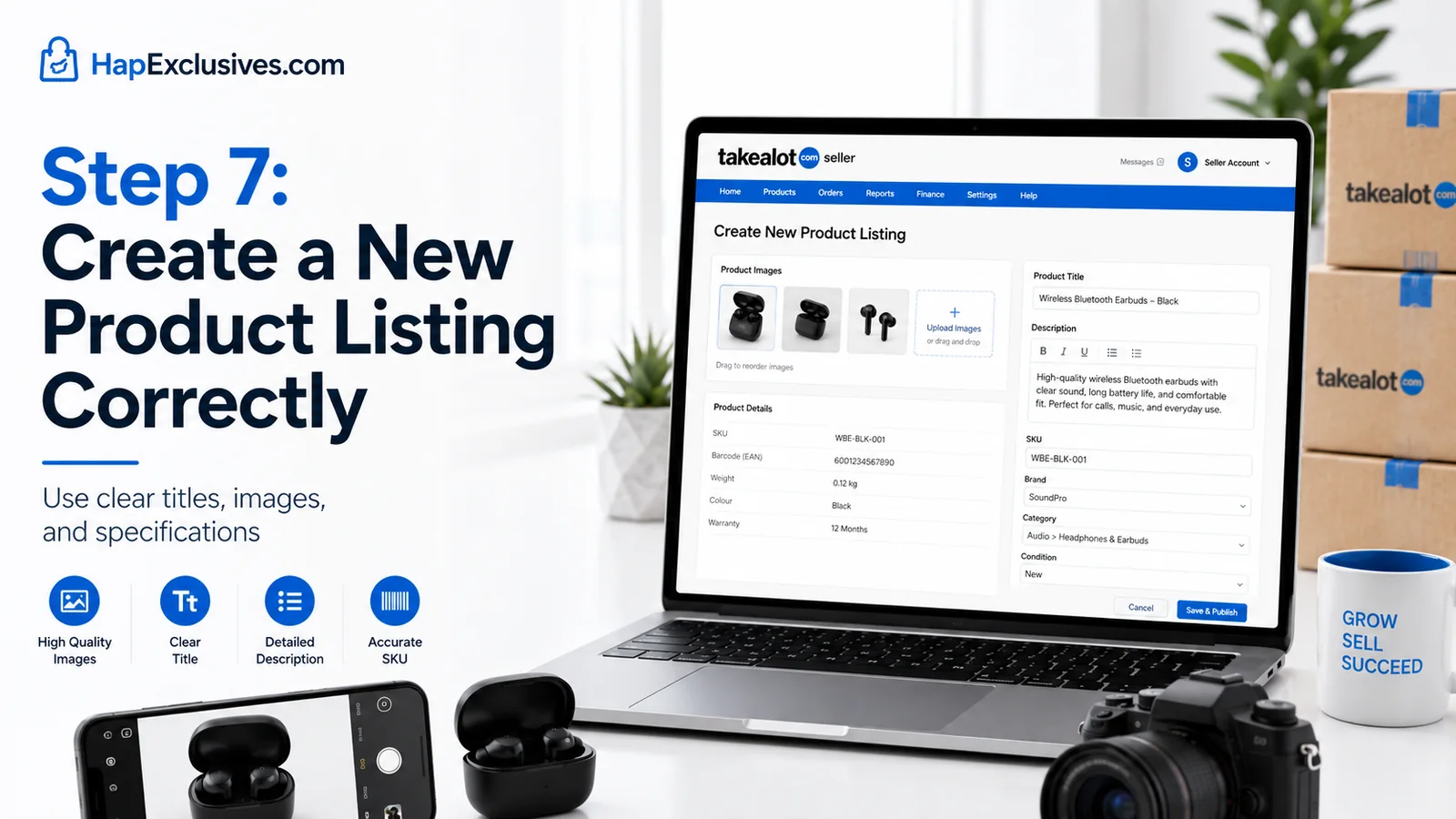
A strong listing answers the important questions before the customer has to ask them. Prepare a structured data sheet, not a description copied from a supplier chat.
- Identity: product name, brand, model, seller SKU and required GTIN or EAN.
- Variation: colour, size, material, compatibility, quantity and exact contents.
- Measurements: product and packaged dimensions and weights.
- Details: features, specifications, usage, safety, warranty and country of origin where required.
- Media: sharp images of the actual product, useful angles, ports, fittings, scale and packaging where relevant.
- Compliance: category-specific documents, warnings and claims you can support.
Write a clear opening paragraph
List exact compatibility
State what is and is not in the box
Use accurate measurements and colour
Explain important limits and care
| Do | Avoid |
|---|---|
| Write a clear opening paragraph | Keyword stuffing and all-capital titles |
| List exact compatibility | “Universal” claims you have not tested |
| State what is and is not in the box | Showing accessories that are not included |
| Use accurate measurements and colour | Borrowing another seller’s images or text |
| Explain important limits and care | Unsupported “best” or “number one” claims |
Step 8: Obtain and manage barcodes correctly
A GTIN identifies a specific trade item; it is not a random number placed on a label. A different colour, size, pack quantity, formulation, model or materially different bundle may need a separate identifier.
- Confirm the current category requirement before buying identifiers or printing packaging.
- Use identifiers assigned and managed for the correct brand and trade item.
- Map every variation carefully and test labels before printing in bulk.
- Never copy a competitor’s barcode or buy suspiciously cheap numbers without verifying ownership.
Phase 3: Fulfil, prepare and launch
Step 9: Choose the right fulfilment method
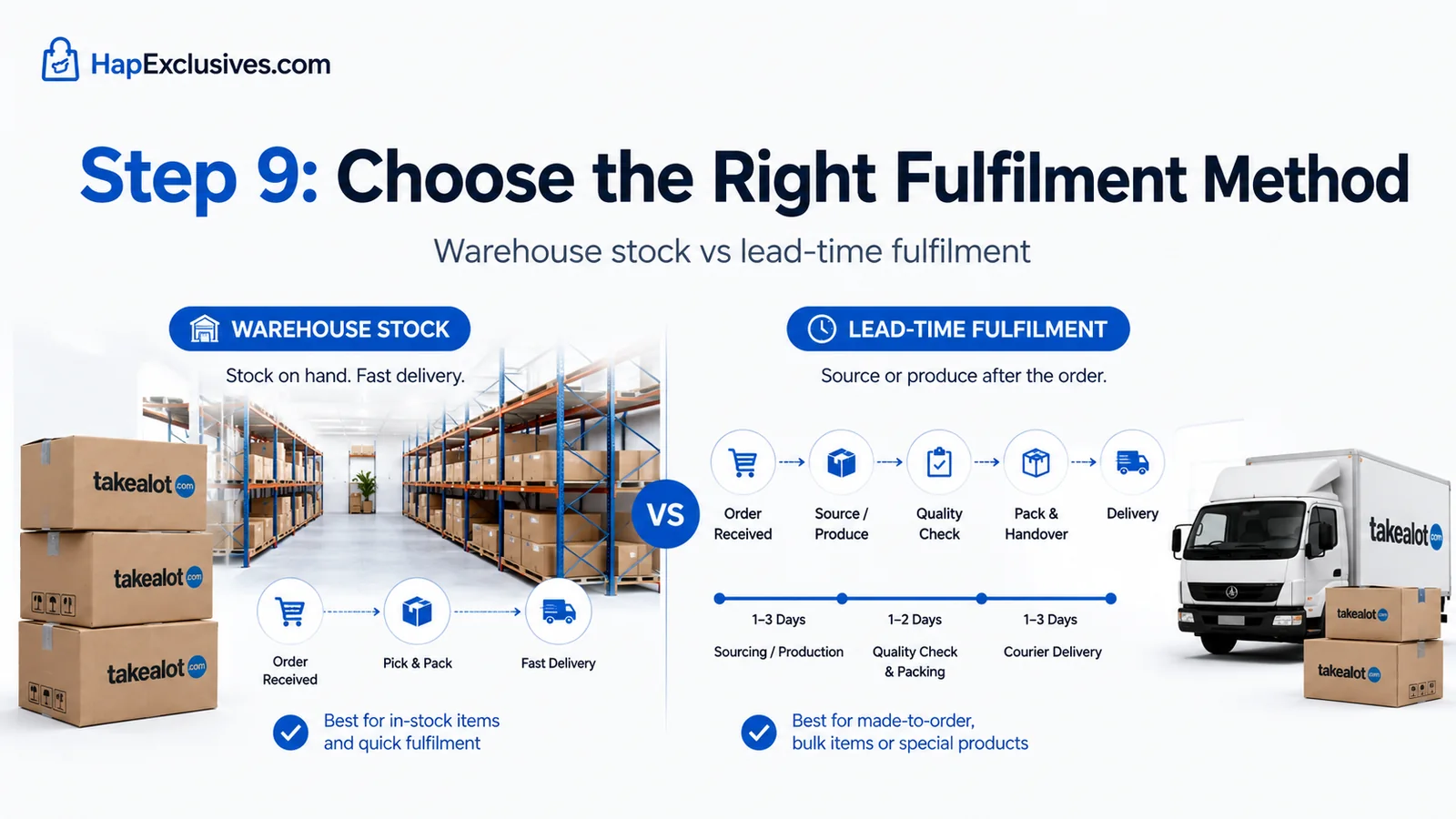
Stock at a Takealot facility
Approved lead-time workflow
Hybrid
| Model | Works well when | Watch out for |
|---|---|---|
| Stock at a Takealot facility | Demand is proven and fast delivery matters | Cash tied in stock, storage exposure and replenishment |
| Approved lead-time workflow | Items are slower, bulky, expensive or made to order | Strict handover deadlines and supplier-stock risk |
| Hybrid | A range mixes proven and experimental products | More processes to monitor consistently |
Step 10: Prepare stock for acceptance
Stock preparation begins at product and packaging design—not on dispatch morning. Every sellable unit should be correct, clean, complete, protected, scannable and consistent with the listing.
- Test the barcode on the exact variation; keep it flat, visible and free from tape glare.
- Record units per carton, carton dimensions and weight, SKUs, quantities, references and destination.
- Photograph carton contents and labels before handover.
- Start with enough stock to learn, but not enough to turn one listing mistake into a warehouse full of regret.
Step 11: Price for profit and competitiveness
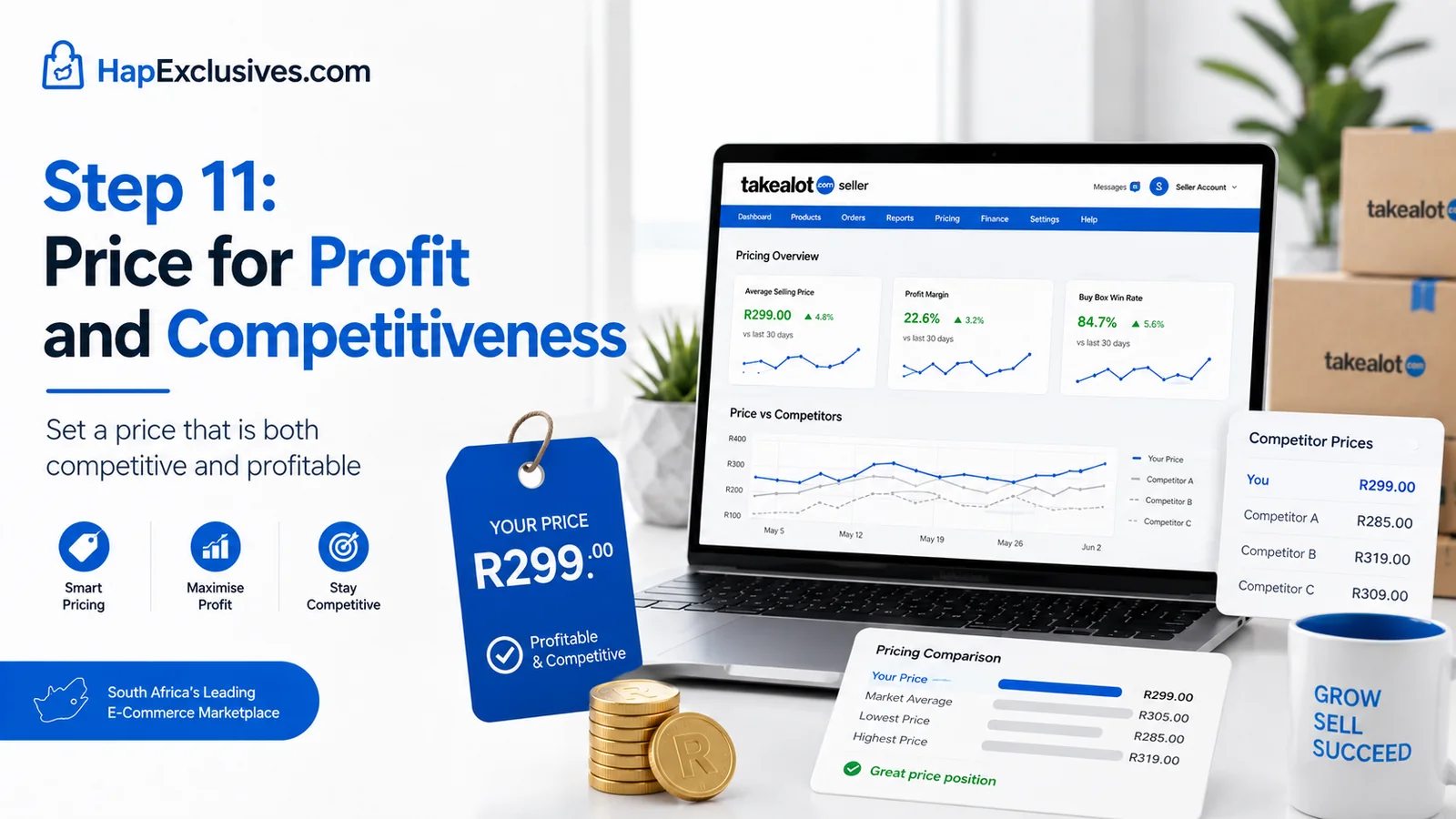
Create a pricing floor that includes landed cost, marketplace charges, preparation, returns, advertising, account overhead and required profit. Below that floor, a sale can increase revenue while weakening the business.
- Check whether the competitor sells the exact same variation.
- Compare delivery promise and fulfilment model, not price alone.
- Ask whether the lower price is a temporary clearance.
- Consider a useful bundle or clearer offer before entering a price war.
- Recalculate after fees, supplier costs or exchange rates change.
“Revenue without contribution is not growth.”
Step 12: Launch a focused first range
A controlled first launch is easier to finance and improve than hundreds of unrelated SKUs. Start with one main product, a few sensible variations, a complementary accessory and perhaps one real bundle.
- Before launch: verify product page, variation, price, VAT treatment, barcode, stock, fulfilment, measurements, contents, images and margin.
- During the first weeks: check views, sales, stock, delivery estimates, competitor prices, reviews, returns, fees and account warnings daily.
- Replace assumptions with actual data as soon as it becomes available.
Phase 4: Protect cash, customers and the business
Step 13: Understand payouts and cash flow
Takealot currently advertises seller payments four times per month, but an order is not instant free cash. You may need to replenish stock, pay freight, cover VAT and absorb deductions before the next payout.
- Reconcile units, selling prices, discounts, marketplace charges and returns.
- Include storage and promotional charges where applicable.
- Match the net statement amount to the bank deposit.
- Compare the final result with product-level landed cost and contribution.
Step 14: Plan for returns before they happen
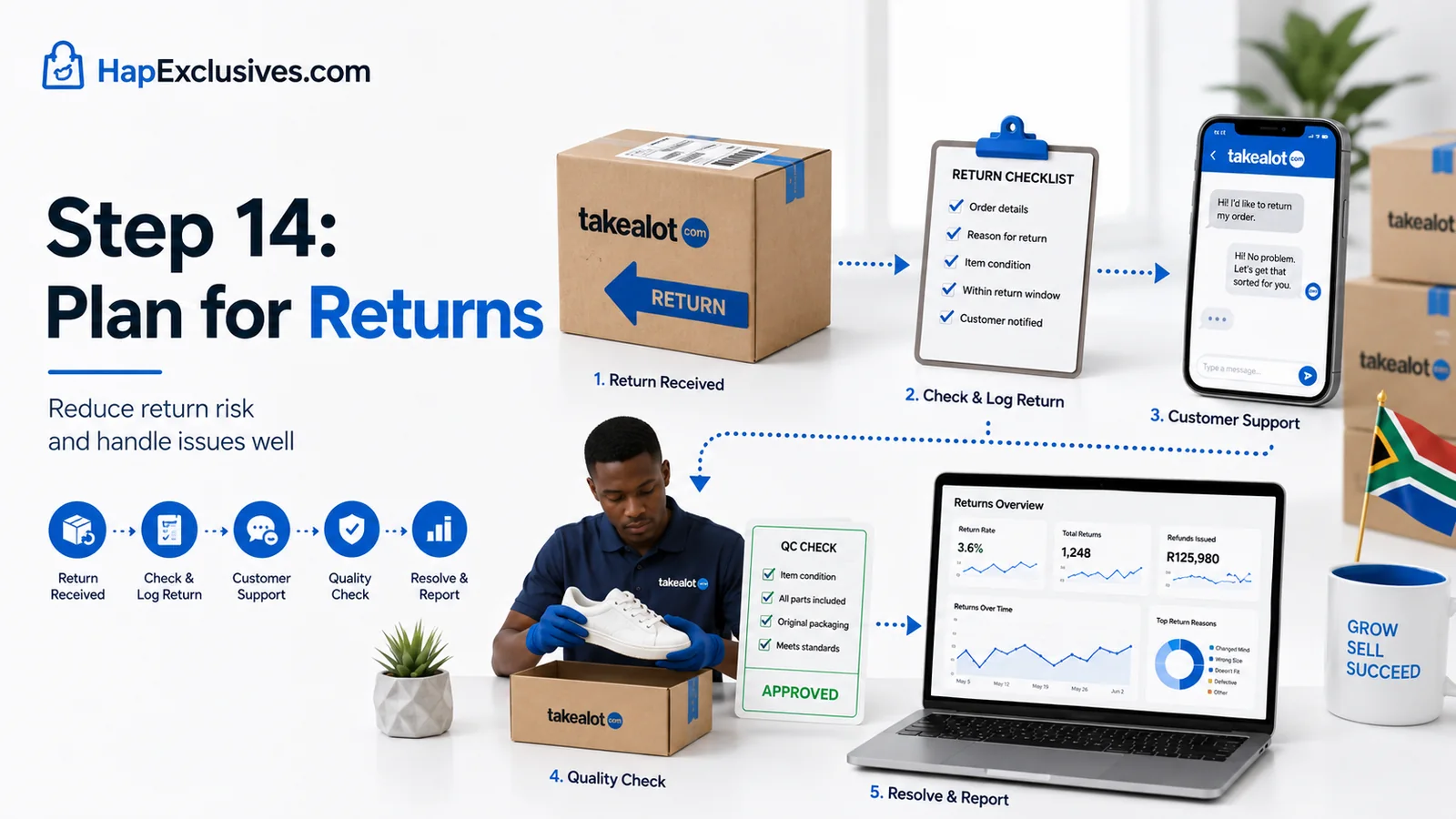
Reduce preventable returns with exact compatibility, accurate colours, measurements, complete contents, tested samples, protective packaging and honest claims. Then group return reasons monthly and fix what you control.
- Product defect or missing component.
- Wrong item or variation.
- Damage in packaging or handling.
- Incompatibility or unclear setup.
- Misleading description, image or colour expectation.
- Customer preference, suspected misuse or unknown cause.
Step 15: Manage VAT, tax and product compliance
SARS states that from 1 April 2026 the compulsory VAT-registration threshold is R2.3 million and the voluntary threshold is R120,000, subject to the relevant conditions. Your total taxable turnover may extend beyond one marketplace account, so get advice for your actual business.
- Price with the correct VAT treatment and keep supplier and import records.
- Check category-specific electrical, radio, food, cosmetic, health, children’s-product or material rules.
- Confirm import permissions, brand authorisation, intellectual-property ownership, warranties, instructions and warnings.
- Remember that supplier availability does not prove that a product can legally or safely be sold in South Africa.
Step 16: Improve after launch
Growth should come from repeatable improvements—not random catalogue expansion.
Clearer titles and images
Better compatibility and contents
Answer recurring customer questions
Fix variation mistakes
| Improve conversion | Improve profit | Improve stock |
|---|---|---|
| Clearer titles and images | Renegotiate supplier pricing | Set minimum and maximum levels |
| Better compatibility and contents | Reduce packaging volume and freight | Reorder from sales velocity |
| Answer recurring customer questions | Remove persistent loss-making SKUs | Investigate ageing inventory |
| Fix variation mistakes | Spend ads only where margin supports it | Reduce unpredictable quantities |
A practical 30-day launch plan
1–5
6–10
11–15
16–20
21–25
26–30
| Days | Focus | Finish with |
|---|---|---|
| 1–5 | Research three to five products, competitors, samples and compliance | A shortlist with evidence |
| 6–10 | Model landed cost, fees, downside scenarios and pricing floors | A maximum buy quantity and go/no-go decision |
| 11–15 | Prepare application, banking, supplier and product information | Clean documents and SKU templates |
| 16–20 | Prepare images, titles, descriptions, variations and barcodes | A catalogue-ready data pack |
| 21–25 | Complete onboarding, submit listings and prepare controlled stock | Approved workflows and checked units |
| 26–30 | Activate offers and monitor price, stock, fees and issues | A live learning loop—not autopilot |
Common mistakes that get expensive
- Pricing from supplier cost only instead of full landed and operating cost.
- Buying too much initial stock because the supplier offered a bulk discount.
- Copying another listing or joining a merely similar product page.
- Using invalid barcodes or mapping one barcode to unrelated variations.
- Entering product dimensions instead of final packaged dimensions.
- Ignoring returns, supplier inconsistency or compliance obligations.
- Starting with too many SKUs to monitor properly.
- Competing only on price and crossing the pricing floor.
- Treating lead time as informal dropshipping.
- Failing to reconcile payout statements against real product costs.
- Buying products on Takealot to resell on Takealot; the public platform terms prohibit reselling items bought there.
Frequently asked questions
How much does it cost to sell on Takealot?
Takealot’s public seller page currently advertises a R400 monthly subscription per seller account, exclusive of VAT. Success, fulfilment, storage and other charges may apply. Use the official Fee Estimator and your Seller Portal figures before setting a price.
Do I need a registered company?
The application asks about you, your business and products, and approval is subject to verification. Use the seller application that matches your real operating structure and provide the documents Takealot currently requests.
Do I need to be VAT registered?
Not every new seller is automatically required to register. SARS’s current thresholds and conditions apply to the business’s taxable turnover. Ask a qualified South African accountant or tax practitioner about your situation.
Do I need a barcode for every product?
Requirements depend on the category, brand, product and variation. When a GTIN is required, use a valid identifier assigned to the exact trade item and confirm the latest portal requirement before printing labels.
Can several sellers sell the same product?
Yes. Takealot’s public terms explain that multiple marketplace sellers may offer the same exact product at different prices. Your offer must match the product page accurately.
Can I sell without sending stock to a Takealot warehouse?
An approved lead-time workflow may be available for suitable products and accounts. You still need dependable stock and must meet the current handover deadlines shown in your portal.
How long does seller approval take?
Takealot’s public seller page currently says it will review an application and get in touch within 10 business days. That is not a guarantee that every account or product listing will be approved within that period.
When does Takealot pay sellers?
The public seller page advertises direct payments four times per month. Reconcile the exact dates, deductions and net amounts shown in your own portal and statements.
Official sources and next steps
Marketplace rules change. Use this guide as a decision framework, then confirm live fees, fulfilment rules and category requirements in official tools before you commit stock.
Want help turning the plan into clean inputs?
HAP Exclusives provides independent, scoped support for South African marketplace sellers—from sourcing and landed-cost planning to GS1/EAN readiness, listing-input preparation, image briefs, packaging instructions and catalogue reviews.
We do not approve accounts, control Takealot’s decisions or guarantee sales, rankings or Buy Box results. The goal is a cleaner decision, a clearer workflow and working files your business keeps.
Found this helpful?
Share it with someone who may need it.